
Is 169 a Prime Number? Clear Answer, Factorization & Explanation
169 is not a prime number. It is a composite number because it can be factored as 13 × 13.
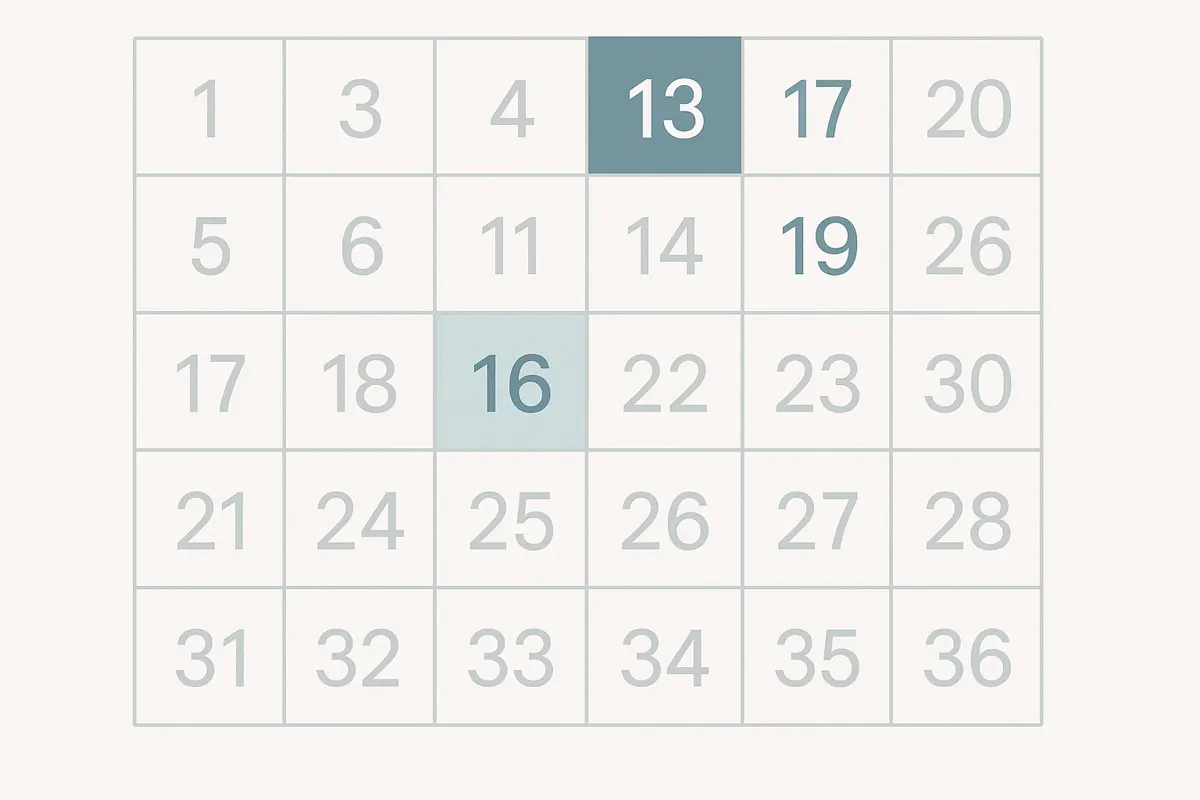
Is 169 Prime? The Direct Answer
No, 169 is not a prime number. Prime numbers have exactly two positive divisors: 1 and themselves. 169 has more than two divisors.
Factorization of 169
The factorization of 169 is 13 × 13, or 13 squared. Its divisors are 1, 13, and 169. Since it has divisors other than 1 and itself, it is composite.
Why Isn’t 169 Prime?
A prime number has only two divisors: 1 and itself. 169 can be divided evenly by 13 (since 13 × 13 = 169), so it has three divisors (1, 13, 169). This means it is not prime.
How to Spot Prime Numbers Faster
Quickly identifying whether a number is prime or composite is a valuable math skill. Games like Prime 59 challenge you to spot primes against the clock, helping you practice mental math and factorization in a fun way.
Train your eye for primes the fun way - Prime 59 is a free, race-the-clock prime-spotting game.
Try Prime 59FAQ
What are the factors of 169?
The factors of 169 are 1, 13, and 169. Its prime factorization is 13 × 13.
Why is 169 not a prime number?
Because it has more than two divisors: 1, 13, and 169. Primes have exactly two divisors.
Is 169 a perfect square?
Yes, 169 is a perfect square because it equals 13 × 13.
How can I get better at spotting prime numbers?
Practice by challenging yourself with mental math puzzles, such as playing Prime 59, where you spot primes quickly.
What is the difference between composite and prime numbers?
Prime numbers have only two divisors (1 and itself), while composite numbers have more than two divisors.