
Is 1 a Prime Number? The Clear Answer, Factorization, and Why
1 is not a prime number. By definition, 1 is neither prime nor composite because it has only one positive divisor: itself.
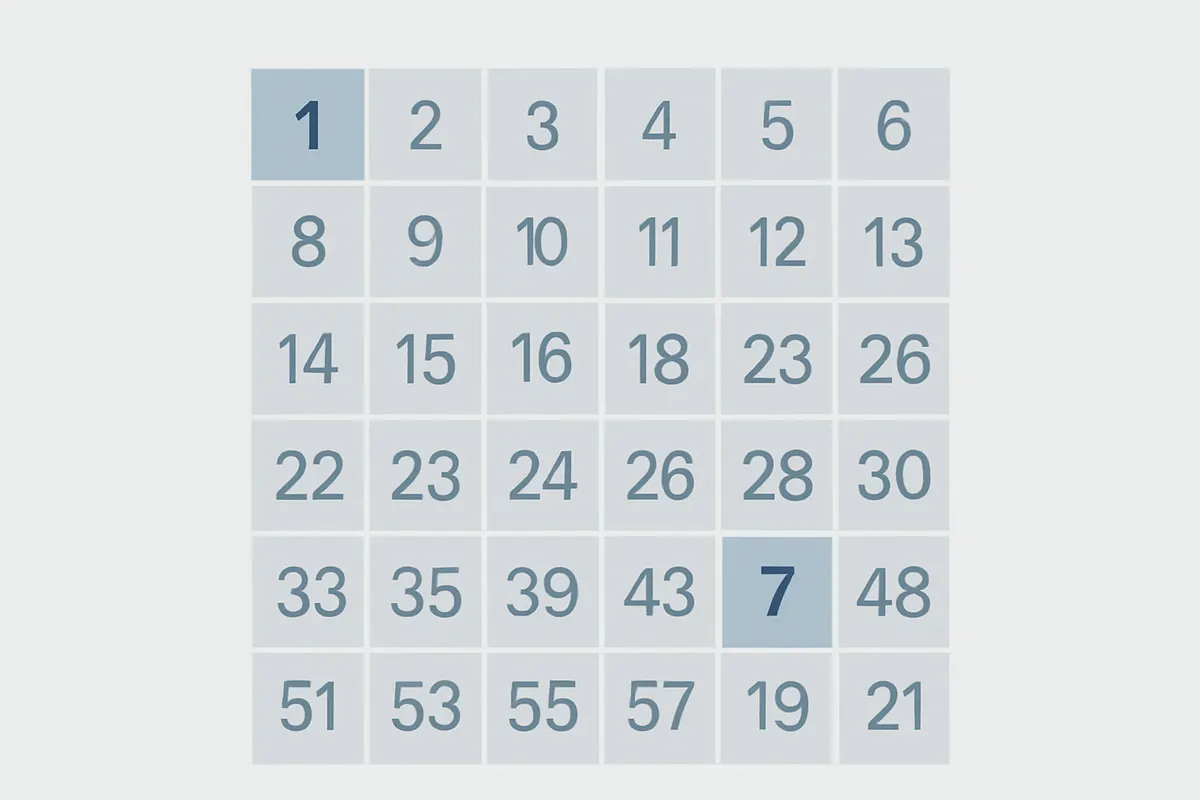
Is 1 Prime? The Definitive Answer
No, 1 is not a prime number. A prime number must have exactly two distinct positive divisors: 1 and itself. The number 1 only has one positive divisor (1).
Factorization of 1
The only way to express 1 as a product of positive integers is 1 × 1 = 1. There are no other positive divisors or factors for 1.
Why 1 is Not Prime: The Plain-English Reason
- Primes have two distinct positive divisors: 1 and the number itself.
- 1 only has one positive divisor: itself.
- This means 1 does not meet the definition of a prime number and is also not composite.
How to Spot Primes Quickly
Spotting primes means knowing the definition and quickly checking divisors. Practicing with mental math games like Prime 59 can help you sharpen your ability to recognize primes and avoid common mistakes, such as misclassifying 1 as prime.
Train your eye for primes the fun way - Prime 59 is a free, race-the-clock prime-spotting game.
Try Prime 59FAQ
Why isn't 1 considered a prime number?
A prime number must have exactly two distinct positive divisors: 1 and itself. The number 1 only has one positive divisor (1), so it does not qualify.
What is the factorization of 1?
The only factorization of 1 is 1 × 1 = 1. There are no other positive divisors or ways to factor 1.
Is 1 considered a composite number?
No, 1 is not composite. Composite numbers have more than two positive divisors. 1 has only one.
What is the smallest prime number?
The smallest prime number is 2. It is the first number that has exactly two positive divisors: 1 and 2.
How can I get better at spotting prime numbers?
You can improve your ability to spot primes by practicing with mental math games like Prime 59, which challenges you to identify primes quickly.