
Is 111 a Prime Number? Clear Answer, Factorization & Why
111 is not a prime number. It is a composite number because it can be factored into 3 × 37.
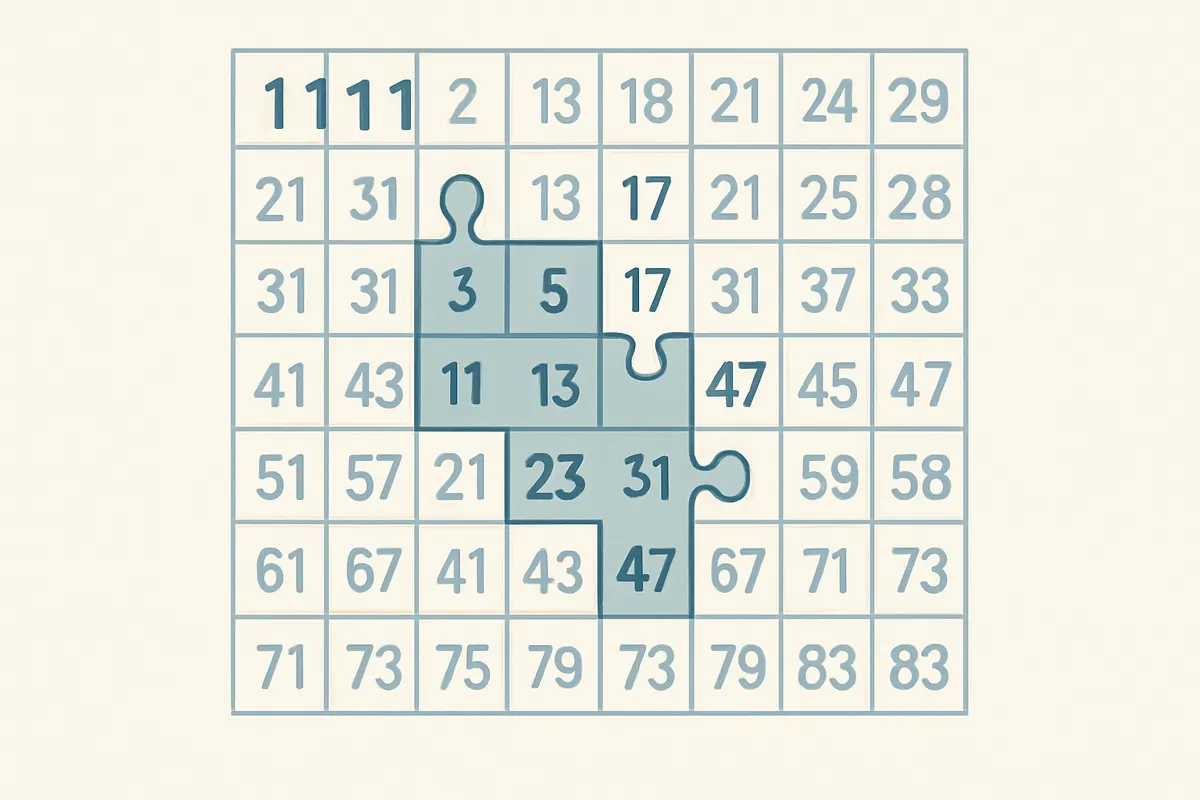
Is 111 Prime or Composite?
111 is a composite number. A prime number has exactly two divisors: 1 and itself. Since 111 can be divided evenly by numbers other than 1 and 111, it is not prime.
Factorization of 111
The factorization of 111 is 3 × 37. This means 3 and 37 are both divisors of 111, along with 1 and 111 itself. You can check this by multiplying 3 × 37, which equals 111.
Why 111 Is Not Prime: The Reason Explained
- The sum of 111's digits is 1 + 1 + 1 = 3, which is divisible by 3.
- If the sum of a number's digits is divisible by 3, the number itself is also divisible by 3.
- Since 111 is divisible by 3 (and 37), it has more than two divisors, so it is composite.
How to Spot Primes Faster
Learning tricks like checking divisibility by small numbers (such as 3 or 5) helps you quickly determine if a number is prime. If you want to get faster at spotting primes and doing mental math, try playing Prime 59, a fast-paced game where you race the clock to pick out prime numbers from composites.
Train your eye for primes the fun way - Prime 59 is a free, race-the-clock prime-spotting game.
Try Prime 59FAQ
What are the factors of 111?
The factors of 111 are 1, 3, 37, and 111.
Why is 111 not a prime number?
111 is not prime because it can be divided evenly by 3 and 37, in addition to 1 and itself.
How do you know if 111 is divisible by 3?
Add the digits: 1+1+1=3. Since 3 is divisible by 3, so is 111.
What is the prime factorization of 111?
The prime factorization of 111 is 3 × 37.
How can I get better at spotting prime numbers?
Practice using divisibility rules and try games like Prime 59 to sharpen your prime-spotting speed.