
Is 101 a Prime Number? Yes, Here's Why
Yes, 101 is a prime number. Its only divisors are 1 and 101, making it the smallest three-digit prime.
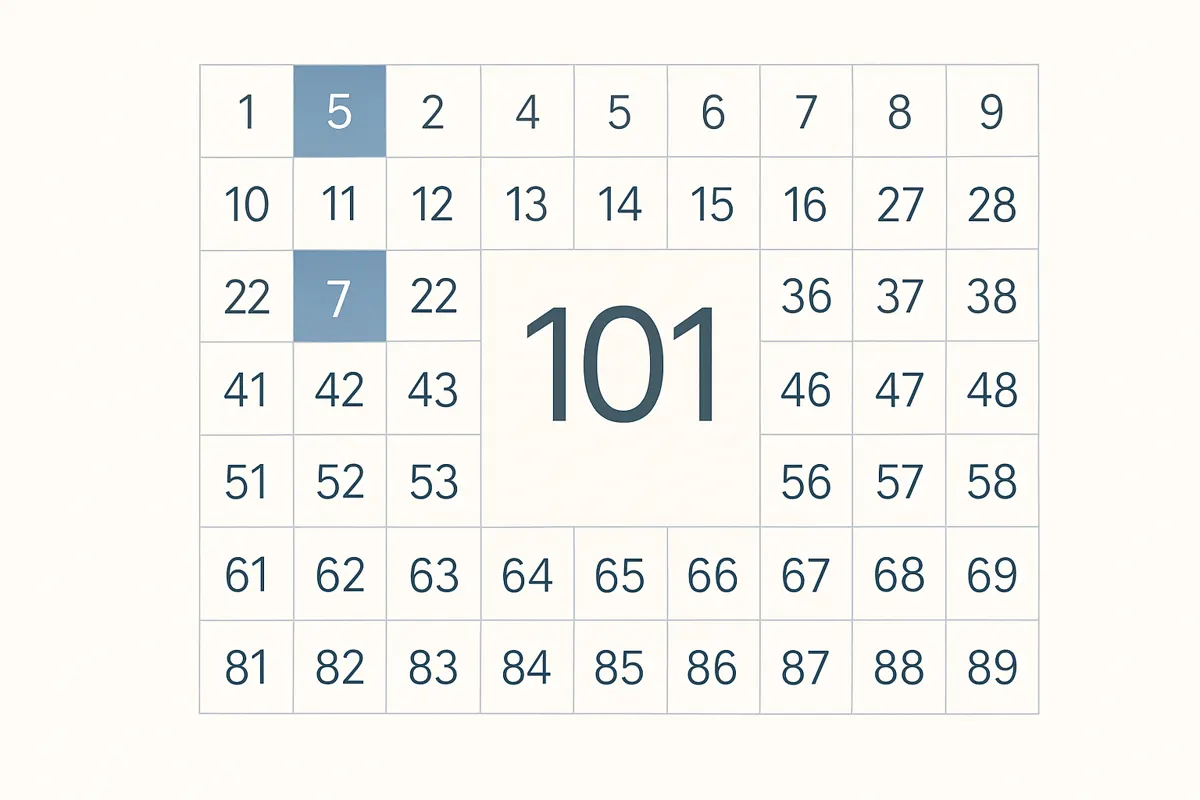
Why 101 Is Prime
A prime number is defined as a whole number greater than 1 that has exactly two positive divisors: 1 and itself. 101 meets this definition because it cannot be divided evenly by any other whole number.
Factorization of 101
The only way to factor 101 is as 1 × 101. There are no other combinations of whole numbers that multiply to 101, confirming it has no divisors other than 1 and itself.
How to Check If 101 Is Prime
- Test divisibility by every whole number between 2 and 10 (the square root of 101 is just over 10).
- 101 is not divisible by 2 (it's odd), 3, 5, 7, or any other number up to 10.
- Since 101 is not divisible by any of these, it is confirmed to be prime.
Why Prime Numbers Matter
Prime numbers like 101 are the building blocks of all natural numbers. Quickly recognizing primes is a valuable mental math skill. You can sharpen this skill by playing Prime 59, a fast-paced game where you race to spot prime numbers against the clock.
Related Facts
- 101 is the smallest three-digit prime number.
- 101 and 103 are a twin-prime pair (they differ by 2).
Train your eye for primes the fun way - Prime 59 is a free, race-the-clock prime-spotting game.
Try Prime 59FAQ
Is 101 a prime or composite number?
101 is a prime number because its only divisors are 1 and 101.
What is the factorization of 101?
The only factorization of 101 is 1 × 101.
Why can't 101 be divided by other numbers?
101 cannot be evenly divided by any whole number other than 1 and 101, which makes it prime.
How can I get better at spotting prime numbers like 101?
Practice regularly with games like Prime 59, where you race to identify primes quickly and sharpen your mental math.
Are 101 and 103 related as primes?
Yes, 101 and 103 are twin primes because they are both prime and differ by 2.