
What is Prime Factorization? Clear Explanation with Examples
Prime factorization breaks a number into its prime number building blocks. Learn how it works with step-by-step examples and practical tips.
What is Prime Factorization? Clear Explanation with Examples
Prime factorization is a fundamental concept in mathematics that involves breaking down a number into the prime numbers that multiply together to give the original number. This concept is essential for understanding divisibility, simplifying fractions, and solving various math problems.
Understanding Prime Numbers and Factorization
A prime number is a number greater than 1 that only has two divisors: 1 and itself. Examples include 2, 3, 5, 7, 11, and so on. Factorization is the process of writing a number as a product of its factors. Prime factorization takes this a step further by expressing a number as a product of only prime numbers.
How to Find the Prime Factorization
To find the prime factorization of a number, you repeatedly divide the number by the smallest possible prime number until all remaining factors are prime. Here’s how it works in practice:
- Example 1: Prime factorization of 30
Start with 30. The smallest prime that divides 30 is 2 (since 30 is even).
30 ÷ 2 = 15
Next, the smallest prime for 15 is 3.
15 ÷ 3 = 5
5 is itself a prime number.
So, the prime factorization of 30 is 2 × 3 × 5. - Example 2: Prime factorization of 84
84 ÷ 2 = 42
42 ÷ 2 = 21
21 ÷ 3 = 7
7 is a prime number.
So, the prime factorization of 84 is 2 × 2 × 3 × 7 or 22 × 3 × 7.
Why is Prime Factorization Useful?
Prime factorization is more than a school exercise—it has many practical uses:
- Finding greatest common divisors (GCD) and least common multiples (LCM)
- Simplifying fractions to their lowest terms
- Coding and cryptography, where prime numbers play a key role
- Puzzle games that use prime numbers for logic and problem-solving
For example, in the number-logic puzzle game Prime 59, players fill a 6x6 grid with prime numbers so that every row and column adds up to 59. Understanding prime factorization can help players quickly identify which combinations of primes can sum to specific totals, making it a helpful skill for tackling daily challenges and competing on leaderboards.
Tips for Practicing Prime Factorization
- Start dividing by the smallest primes (2, 3, 5, 7) and work up.
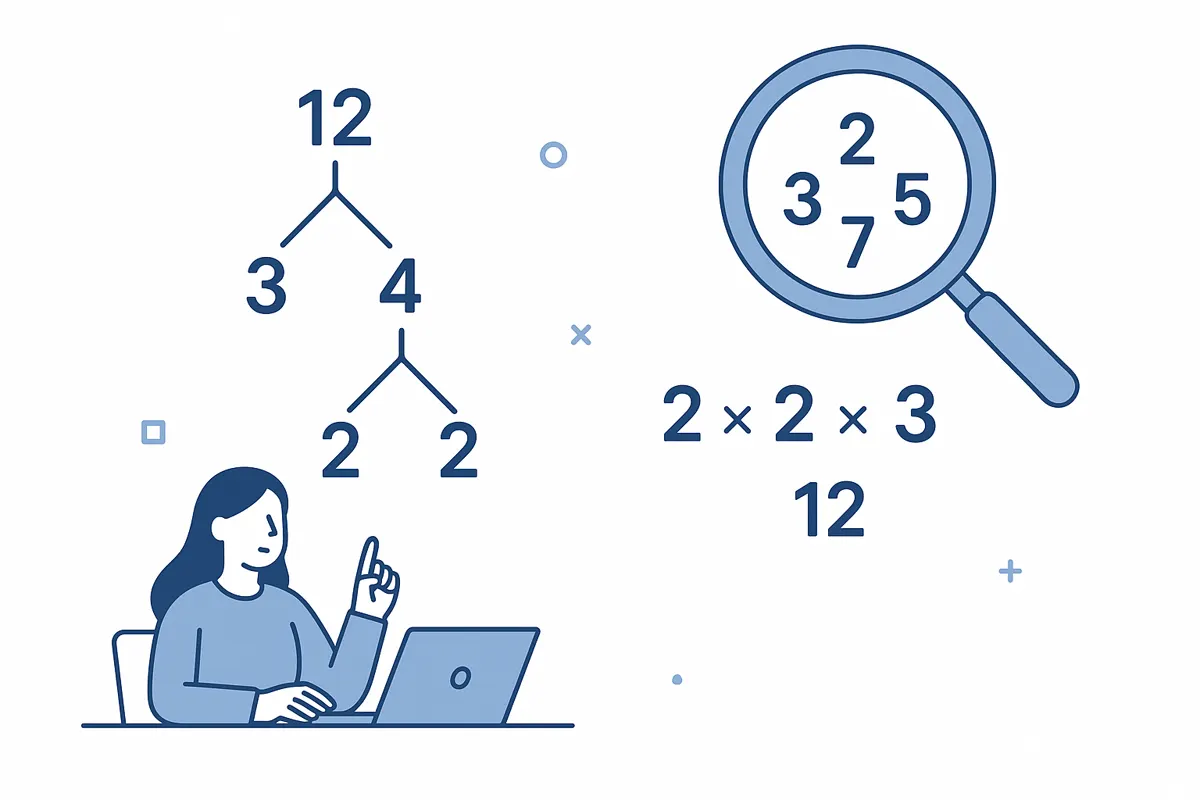
- Use a factor tree to visually break down numbers step by step.
- Practice with different numbers to recognize patterns.
- Try logic games like Prime 59 to apply your skills in a fun way.
Prime factorization is a building block for many areas of math. With regular practice and by using engaging puzzles, you can strengthen your number sense and problem-solving abilities.
Get a personalized read from Prime 59.
Try Prime 59