
Is 91 a Prime Number? Yes or No, Factorization, and Explanation
91 is not a prime number. It is a composite number because it can be factored into 7 × 13.
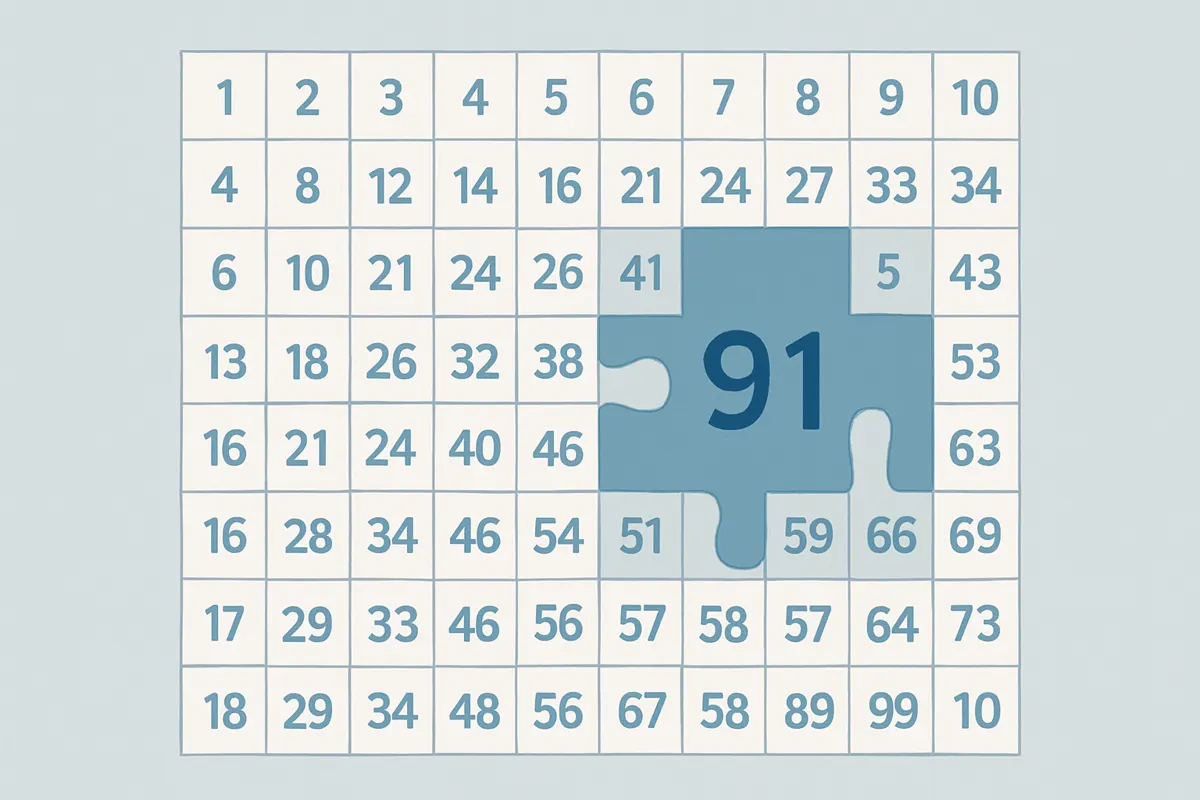
Is 91 a Prime Number?
No, 91 is not a prime number. A prime number has exactly two positive divisors: 1 and itself. 91 has more than two divisors, so it is composite.
Factorization of 91
The correct factorization of 91 is 7 × 13. Both 7 and 13 are prime numbers, and their product is 91. This means 91 can be divided evenly by numbers other than 1 and 91 itself.
- 91 ÷ 7 = 13
- 91 ÷ 13 = 7
Why 91 Is Often Mistaken for a Prime
Many people assume 91 is prime because it is odd and not divisible by 2, 3, or 5. However, checking divisibility by higher primes like 7 and 13 reveals that 91 is composite. This makes 91 a common trap for those learning to spot primes quickly.
Sharpen Your Prime-Spotting Skills
Spotting composite numbers like 91 gets easier with practice. Prime 59 is a fast-paced puzzle game where you race the clock to identify prime numbers. Playing regularly can help you develop the mental agility to spot tricky composites and primes much more quickly.
Train your eye for primes the fun way - Prime 59 is a free, race-the-clock prime-spotting game.
Try Prime 59FAQ
What are the factors of 91?
The factors of 91 are 1, 7, 13, and 91.
Why is 91 not a prime number?
91 is not a prime number because it can be divided evenly by 7 and 13, in addition to 1 and itself.
Is 91 divisible by any prime numbers?
Yes, 91 is divisible by 7 and 13, both of which are prime numbers.
How can I quickly check if numbers like 91 are prime?
Check divisibility by smaller prime numbers up to the square root of the number. Practice with games like Prime 59 can help you get faster at this skill.
What is the prime factorization of 91?
The prime factorization of 91 is 7 × 13.