
Is 59 a Prime Number? Yes. Here’s Why.
59 is a prime number. It has exactly two divisors: 1 and 59 itself.
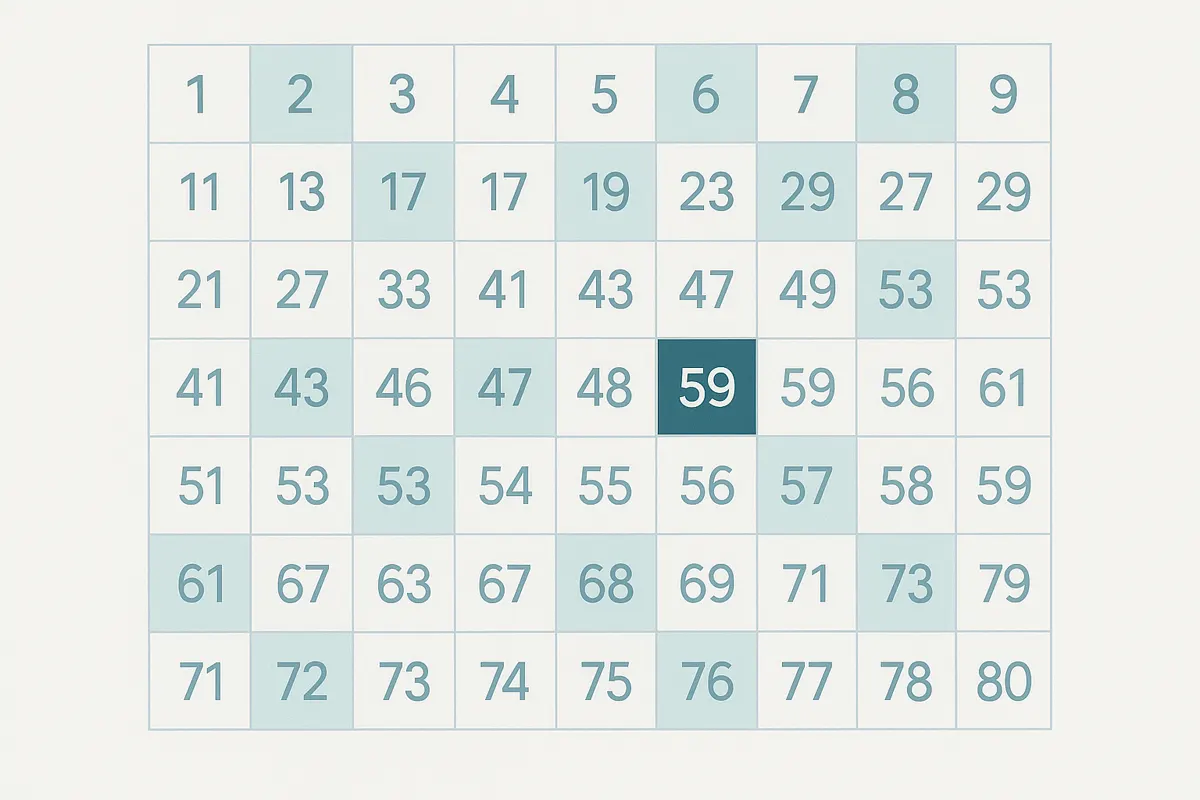
Prime Status of 59: The Facts
59 is a prime number. That means it cannot be divided evenly by any number other than 1 and itself. There are no whole numbers (other than 1 and 59) that multiply together to make 59.
Factorization of 59
- 59 = 1 × 59
These are the only whole-number factors of 59. It is not divisible by 2, 3, 5, or 7 (the primes less than its square root), confirming its prime status.
Why Is 59 Prime? A Plain-English Explanation
A prime number has exactly two positive divisors: 1 and itself. Since nothing else divides 59 evenly, it meets this definition. If you try dividing 59 by any whole number from 2 up to 7, you always get a remainder.
59 and Twin Primes
59 and 61 form a twin-prime pair. Twin primes are two prime numbers that differ by just 2. This makes 59 interesting for those who like patterns in numbers.
Sharpen Your Prime-Spotting Skills
If you want to get better at recognizing prime numbers like 59 quickly, try playing the Prime 59 game. It’s a fast-paced mental math challenge where you race to spot primes, helping you build confidence and speed in prime identification.
Train your eye for primes the fun way - Prime 59 is a free, race-the-clock prime-spotting game.
Try Prime 59FAQ
Is 59 a prime number?
Yes, 59 is a prime number. Its only divisors are 1 and 59.
What is the factorization of 59?
The only whole-number factorization of 59 is 1 × 59.
Why is 59 considered prime?
59 is considered prime because no whole number except 1 and 59 divides it evenly.
Is 59 divisible by any smaller primes?
No, 59 cannot be divided evenly by 2, 3, 5, or 7.
How can I improve at spotting prime numbers like 59?
You can practice identifying primes quickly by playing mental math games like Prime 59.